
Balcony & Deck
Specialized repairs for outdoor elevated areas suffering from water ingress and timber rot.
Balconies and decks are highly exposed to the elements and prone to membrane failure.
We provide structural repairs, timber restoration, sanding, oiling, and heavy-duty waterproofing to make your outdoor areas safe and usable again.
From tiled balconies to timber decks, we ensure proper drainage and sealing.
Why Choose Us?
- Structural integrity restored
- Weather-resistant coatings
- Improved drainage
- Safe outdoor living
Ready to fix your balcony & deck issue?
Contact us today for a comprehensive assessment and quote.
Signs your balcony or deck needs work
- Water leaking into the room or garage below
- Cracked, loose or drummy balcony tiles
- Water pooling instead of draining after rain
- Spalling concrete or rust stains on the underside
- Soft, splintered, greyed or rotting deck boards
How it works
- 1
Send photos or call
Tell us what you are seeing and send a few photos. It helps us arrive with the right equipment.
- 2
Inspection and diagnosis
We find the cause, not just the symptom, and explain what we found in plain language.
- 3
Written quote
You get a clear, itemised quote for the agreed scope before any work starts.
- 4
Repair and handover
We complete the work, clean up and walk you through what was done.
Before & After
Recent rear-entry deck restoration — weathered, splintered boards stripped back, replaced with hardwood, sanded and finished with a deep penetrating decking oil.
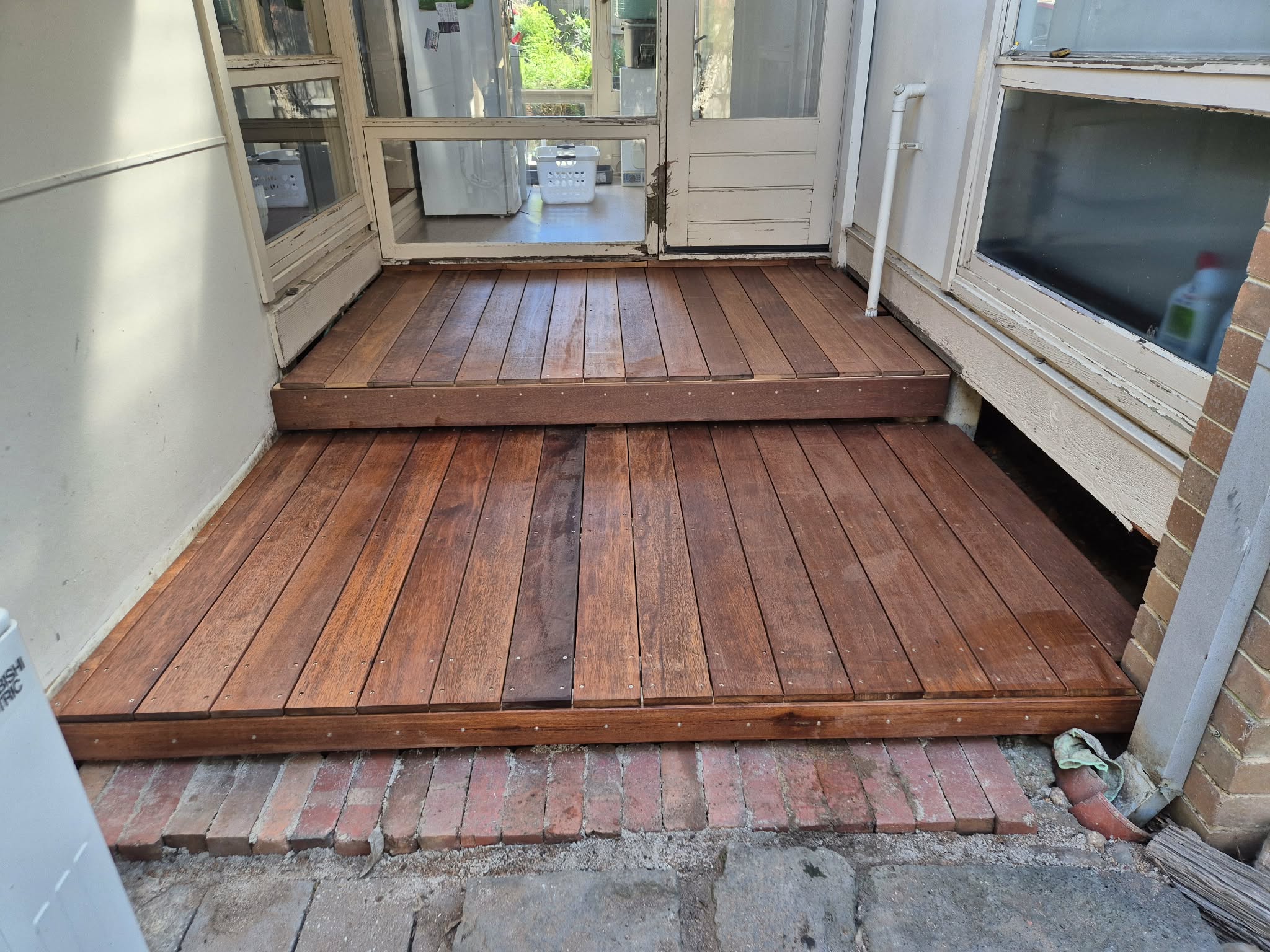
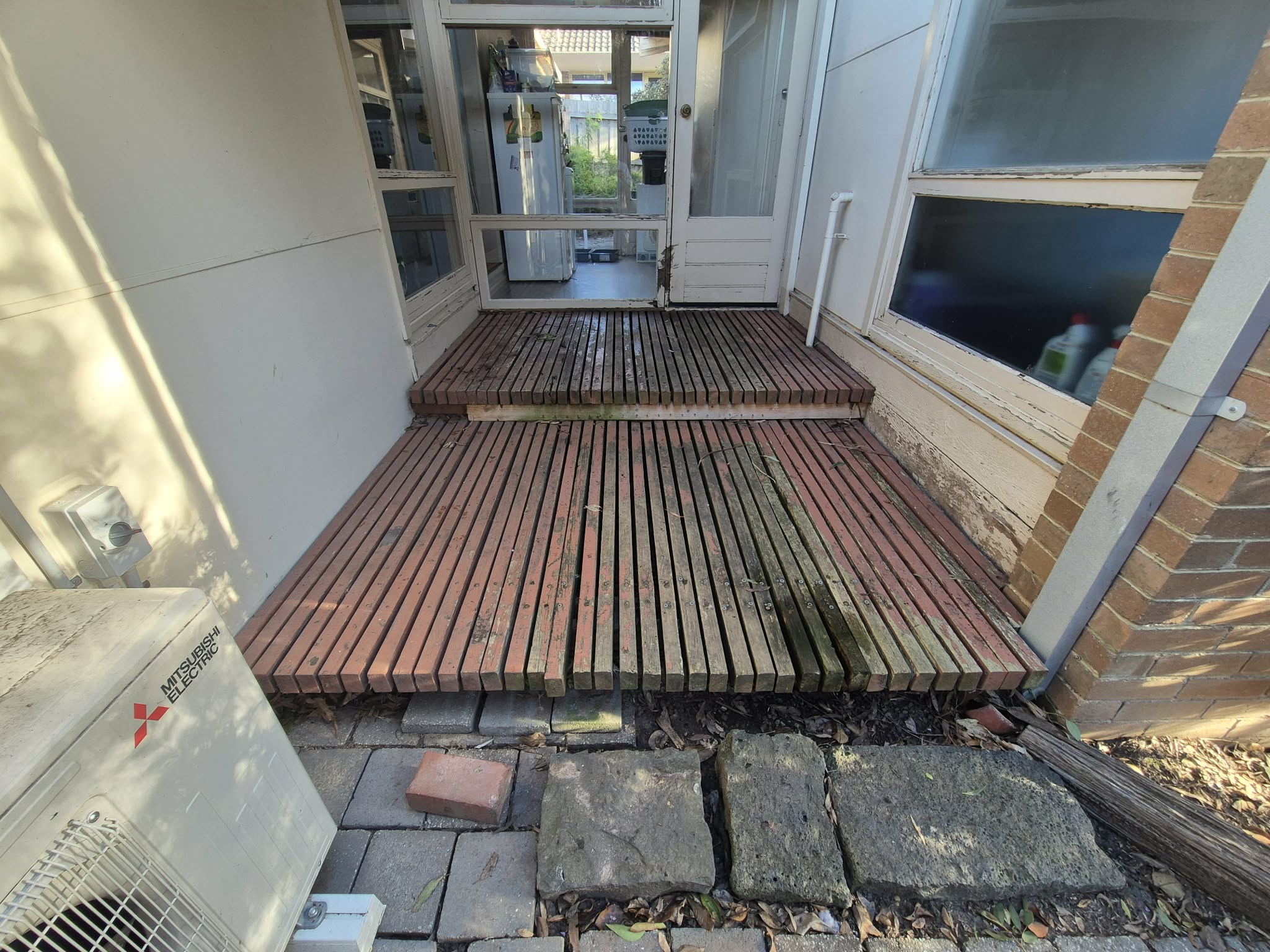
Drag the slider to compare before and after.
Our Results
Real before and after photos from our completed projects.
Balcony & Deck questions
Why is my balcony leaking into the room below?
Balcony leaks into rooms below are most commonly caused by aged or damaged membranes, cracked concrete, failed sealant at wall-floor junctions, blocked drainage causing ponding, or absent original waterproofing in pre-1980s Melbourne buildings.
Root causes include: membrane failure due to age, UV degradation, or original installation defect; cracks in the concrete slab propagating through the membrane; failed or missing sealant at the junction between the slab and building wall or door threshold; blocked drainage causing water to pond and find paths through the membrane; and in older Melbourne buildings (particularly 1960s–1980s construction in suburbs like St Kilda, Elwood, Brighton, and Caulfield), waterproofing was often absent or applied to a standard far below what current codes require. The junction between balcony slab and building wall is the highest-risk point — inspect sealant condition here first.
How do I know if my balcony needs waterproofing or just resealing?
Resealing (sealant renewal at joints) is appropriate when the membrane is sound and only sealant has failed; full waterproofing is required when the membrane itself has cracked, blistered, or degraded, or when water is actively tracking through the slab.
Sealant renewal is the maintenance of flexible silicone joints at specific high-movement locations (wall-slab junctions, around penetrations, at door thresholds). It is appropriate when these joints have deteriorated but the waterproofing membrane beneath is intact and performing. Full waterproofing system replacement is required when: the concrete slab shows cracking; the membrane shows visible signs of failure (blistering, cracking, delamination); water staining is present on the soffit below; or the balcony was built before current standards and has never been properly waterproofed. We inspect and advise which category applies — there's no benefit to us in recommending a full waterproofing job when resealing is genuinely sufficient.
Do you repair concrete cancer on balconies?
Yes — concrete cancer repair (reinforcement corrosion) is a core service, involving breaking out affected concrete, treating or replacing corroded rebar, reinstating with repair mortar, and then waterproofing.
Concrete cancer — the corrosion of embedded steel reinforcement causing cracking and spalling of surrounding concrete — is common on Melbourne balconies, particularly in coastal bayside suburbs (Brighton, Sandringham, Cheltenham, Mordialloc) and in buildings constructed in the 1960s–1980s before modern concrete cover standards were consistently applied. Repair involves: breaking out deteriorated concrete to expose corroded rebar; wire-brushing or mechanically cleaning and applying corrosion inhibitor to the steel; reinstating with an appropriate polymer-modified repair mortar; and then applying waterproofing and reinstating the surface finish. Left untreated, concrete cancer is progressive and ultimately compromises structural integrity.
Can you repair a timber deck that has water damage?
Yes — timber deck repairs range from individual board replacement to full structural reframing, with correct substrate waterproofing essential where the deck is over a habitable area below.
Timber deck repairs range from replacing damaged or rotten individual boards through to full deck strip-and-reframe where the substructure has been compromised by prolonged moisture exposure. Where the deck is constructed over a habitable space (common in Melbourne townhouses and multi-residential buildings in Richmond, Fitzroy, Northcote, and similar inner suburbs), correct waterproofing of the structural substrate before reinstating the deck surface is essential. We assess the extent of structural damage, advise on whether repair or full replacement is appropriate, ensure the substrate waterproofing is correctly installed and detailed, and then reinstate the deck surface in hardwood or composite decking.
Can balcony waterproofing be done in winter?
Yes — balcony waterproofing can be done in Melbourne winters, subject to temperature and moisture conditions at the time of application, with membrane cure times adjusted accordingly.
Most liquid-applied membrane systems have minimum application temperature requirements (typically 5–10°C) and require the substrate to be dry. Melbourne winters are workable with careful scheduling around weather windows — the Bureau of Meteorology forecast is reviewed before scheduling any exterior membrane application. Sheet membranes are less temperature-sensitive and can be installed in cooler conditions. We will not apply liquid membranes in rain or immediately following rain on exterior surfaces. For urgent winter leaks, we can apply temporary protective measures to limit ongoing damage while scheduling the permanent repair for appropriate conditions.